Flamey Says Do The Math!
 Heating Oil Is Climbing. Wood Heat Could Change the Math.
If you heat your home with oil here in the Northeast, you've probably noticed something every time that delivery truck pulls into the driveway:
That fill-up isn't getting any cheaper.
And heading into the 2026–27 heating season, the numbers are getting homeowners' attention.
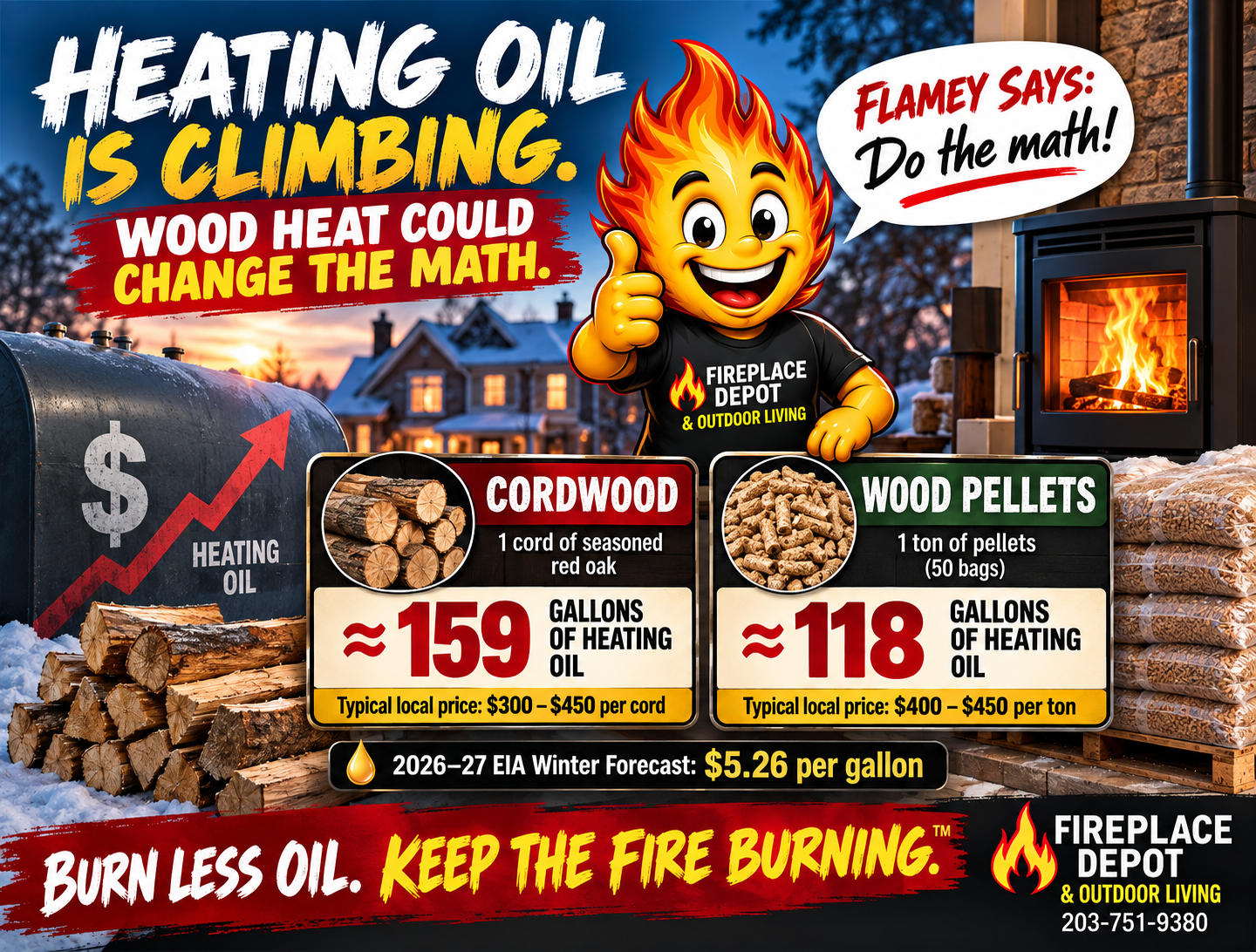
The U.S. Energy Information Administration (EIA) is forecasting residential heating oil to average approximately $5.26 per gallon this winter—34% higher than last winter. Even with the EIA forecasting somewhat lower heating-oil consumption because of warmer expected weather in the Northeast, households that primarily heat with oil are still expected to spend about 21% more this winter.
So maybe the question isn't:
“How do I completely get rid of my oil heat?”
Maybe the better question is:
“How can I burn less of it?”
That's where a wood stove, pellet stove or fireplace insert starts to become pretty interesting.
Let's Do the Math: Firewood vs. Heating Oil
A cord of properly seasoned hardwood contains a tremendous amount of usable energy.
According to Penn State Extension, one cord of seasoned northern red oak can produce approximately the same amount of heat as 159 gallons of fuel oil. Actual results will vary depending on the species and moisture content of the wood, along with the efficiency and operation of both heating systems. But it gives us a useful comparison.
Let's use the EIA's forecast winter heating-oil price of $5.26 per gallon:
159 gallons × $5.26 = about $836
Now compare that with a cord of properly seasoned hardwood.
Depending on the species, supplier and delivery, let's use an illustrative local price of approximately $300–$450 per cord.
Even at the high end:
Heating oil equivalent: approximately $836
One cord of seasoned hardwood: approximately $450
That's a difference of approximately:
$386 per cord.
And if you're able to purchase that cord for around $300?
The difference grows to approximately:
$536 per cord.
Burn two or three cords over the course of a Northeast winter, and now we're talking about real money.
And remember, we're doing this math using the EIA's forecast winter average of $5.26 per gallon. If you're paying more for heating oil locally, the comparison becomes even more interesting.
That's when wood heat starts getting your attention.
What About a Pellet Stove? 🔥
Maybe you like the economics of heating with wood, but splitting, stacking and carrying firewood isn't exactly how you want to spend your weekends.
That's where a pellet stove becomes really interesting.
A standard ton of wood pellets is typically 50 forty-pound bags, often sold together as a pallet.
Depending on the brand, pellet quality, supplier and delivery, let's use an illustrative price of approximately $400–$450 per ton.
Some homeowners may go through roughly a ton during a cold month. Others will use considerably more or less depending on the size and efficiency of the home, outdoor temperatures, thermostat settings, stove output and whether the pellet stove is being used as primary or supplemental heat.
So rather than saying a pallet equals a month of heat or a tank of oil, let's compare the economics on an equivalent-energy basis.
Penn State Extension's Energy Selector compares heating fuels based on their cost for equivalent useful heat. Its comparison shows that when heating oil costs $4.50 per gallon, wood pellets can cost approximately $530 per ton and have a comparable useful-heat cost. That relationship works out to roughly 118 gallons of heating oil per ton of pellets under those assumptions.
Using the EIA's $5.26 winter oil forecast:
118 gallons × $5.26 = about $621
Compare that with:
One ton of pellets: approximately $400–$450
That's a potential fuel-cost difference of approximately:
$171–$221 per ton.
And once again, if you're paying more than $5.26 per gallon for heating oil, the comparison becomes even more favorable.
Flamey Says: Do the Math!
Our buddy Flamey has a pretty simple philosophy:
“We Keep the Fire Burning.”
But keeping the fire burning doesn't mean you have to burn through your heating budget.
Whether it's a cord of seasoned hardwood, a ton of pellets or another supplemental heating option, the goal isn't necessarily to eliminate your existing heating system.
It's to give it some help.
Every gallon of heating oil you don't need to burn is a gallon you don't need to buy.
Burn less oil. Stay warm. Keep the fire burning.
You Don't Have to Get Rid of Your Oil System
This might be the most important point in this entire conversation.
We're not suggesting that every homeowner should rip out their oil boiler or furnace and start living like it's 1850.
That's not the point at all.
Think of supplemental heat as another tool in your toolbox.
If your wood stove, pellet stove or fireplace insert is comfortably heating the areas where your family spends most of its time, your central heating system may not have to carry the entire heating load.
Every gallon of oil you don't need to burn is a gallon you don't need to buy.
And when heating oil is above $5 per gallon, those gallons add up pretty quickly.
Today's Wood Stoves Aren't Grandpa's Old Wood Stove
Wood-burning technology has come a long way.
Modern EPA-certified wood heaters are designed to meet federal particulate-emissions standards, and today's equipment can make much better use of the energy contained in the wood than many older, inefficient wood-burning appliances. EPA says certified stoves can use up to one-third less firewood than older, less-efficient stoves.
Pellet stoves offer another level of convenience.
Pellets provide a consistent fuel source, are relatively easy to store and handle, and modern pellet appliances can offer automatic fuel feeding and temperature control.
You get many of the benefits of heating with a renewable wood fuel without all of the splitting and stacking associated with traditional cordwood.
One Important Detail: Burn Good Wood
If you're heating with cordwood, the quality of your fuel matters. A lot.
EPA guidance recommends burning properly dried firewood with a moisture content of 20% or less.
Why?
Because wet wood wastes energy evaporating moisture instead of producing useful heat. It also creates more smoke and can contribute to creosote buildup.
So don't judge firewood strictly by price.
Properly seasoned wood + the right appliance + proper operation = better heat and better performance.
And regardless of the appliance, proper installation, routine maintenance, chimney inspection and working smoke and carbon-monoxide alarms are essential parts of safely heating your home.
What About Gas or Propane?
Wood and pellets may lead the conversation when we're looking strictly at fuel economics, but they're certainly not the only ways to supplement an oil-fired heating system.
A modern gas or propane fireplace insert offers something that's difficult to beat:
Push-button convenience.
Turn it on when you're using the room. Turn it down or off when you're finished.
For homeowners who value convenience, cleanliness and easy temperature control, a gas or propane insert can be an excellent supplemental heating option.
Will gas or propane always beat cordwood or pellets on fuel cost?
No. And we wouldn't tell you that it will.
But if it allows you to comfortably heat the areas you're actually using while reducing the workload on your oil-fired central heating system, it may still make a lot of sense.
Maybe It's Time to Put Your Fireplace to Work
For years, fireplaces in many homes have been treated mostly as decoration.
Light a fire during the holidays.
Enjoy it when company comes over.
Then go right back to letting the central heating system heat the entire house.
With heating oil forecast to average more than $5 per gallon this winter, maybe it's worth looking at that fireplace a little differently.
A properly selected wood stove, pellet stove, wood insert, gas insert or propane insert can turn that area into a productive supplemental heating source.
You don't necessarily have to stop using oil.
You just need to use less of it.
At Fireplace Depot & Outdoor Living, we can help you look at your home, your existing fireplace, your heating goals and the different options available to determine what makes the most sense for you.
Because when energy prices change, sometimes the smartest thing you can do is change the math.
Burn less oil. Stay comfortable. Keep more of your heating dollars in your pocket.
And, as Flamey likes to say, “We Keep the Fire Burning.”